
By Hammad Khatri, Brand Manager·Apr 10, 2026
An AI citation is a formal attribution that an AI search engine — like SearchGPT, Google's AI Overviews, Gemini, or Perplexity — gives your website when it uses your content to generate an answer. In 2026, earning these citations has become the single most valuable form of search visibility, because the citation places your brand directly inside the AI's response.
The digital landscape is undergoing its most significant transformation since the invention of the hyperlink. We have moved past the era of "ten blue links" and entered the era of the AI search engine. Whether users ask SearchGPT, Google's AI Overviews (SGE), Gemini, or Perplexity, the way people consume information has fundamentally shifted — from browsing websites to reading synthesized, source-cited answers.
In this new reality, the most valuable currency for any creator, agency, or business — from SaaS startups in San Francisco to digital studios in Dubai — is the AI citation. But what exactly is it, how does the underlying technology decide who gets cited, and how do you ensure that when an AI "speaks," it speaks using your words and credits your brand? This complete AI citation guide answers all three questions.
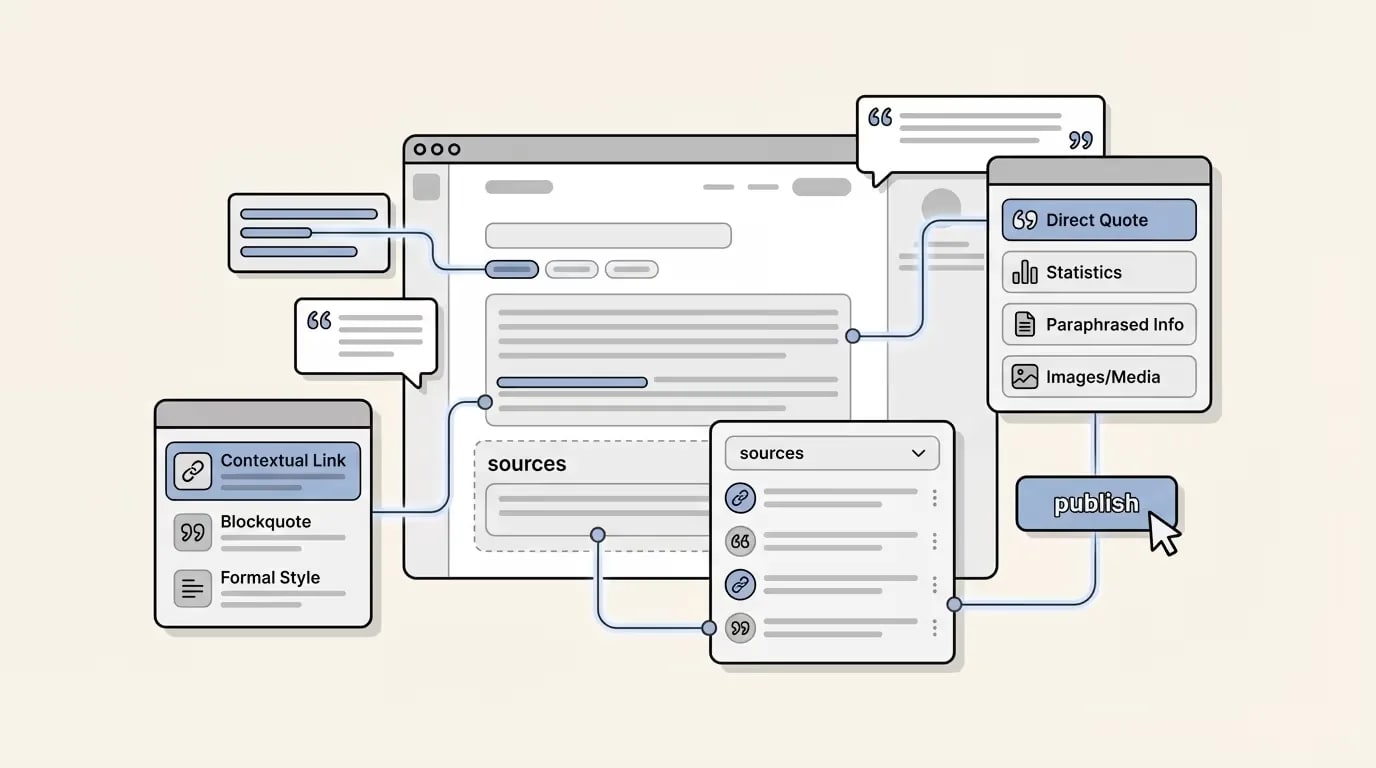
An AI citation is a formal attribution provided by a Large Language Model (LLM) when it uses a specific piece of information from the web to generate a response. Think of it as the AI-era equivalent of ranking #1 on Google — except instead of competing for a position on a results page, you are competing to become the source the AI trusts enough to quote.
Unlike traditional search results, where a snippet of your site appears alongside nine competitors, an AI citation often appears as a small footnote, a clickable inline link within the generated prose, or a source card beside the chat interface. Fewer sources get cited per answer than ever ranked on page one — which means the visibility is more concentrated, more authoritative, and more valuable for the brands that earn it.

To understand how to get cited by AI, we must look under the hood at Retrieval-Augmented Generation (RAG) — the architecture powering virtually every modern AI search engine. These systems do not rely solely on their static training data, which may be months out of date. Instead, every time a user asks a question, the engine follows this five-step workflow:
The AI breaks down the user's conversational query into entities (people, brands, products, concepts) and intents (informational, comparative, transactional) so it knows exactly what kind of answer to construct.
The AI searches a massive, continuously updated index of the live web for the most relevant, high-authority chunks of content — paragraphs, tables, and data points rather than whole pages.
It ranks these retrieved chunks using E-E-A-T signals: Experience, Expertise, Authoritativeness, and Trustworthiness. Content from verifiable experts with original data consistently outranks anonymous rehashed content.
The model writes a single cohesive answer using the top-ranked chunks, blending information from multiple trusted sources into natural prose.
Finally, it attaches an AI content referencing tag — your citation — to the specific sentences derived from your site, linking readers back to your page as the verified source.
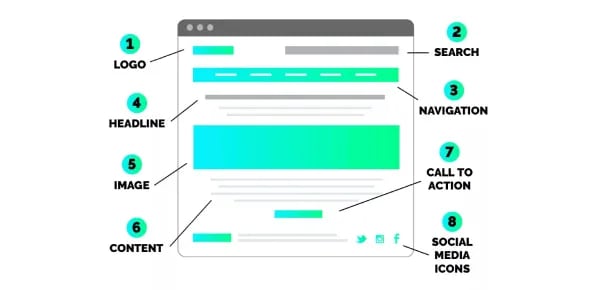
Not all content is citable by an LLM — in fact, most published content is invisible to AI engines because it offers nothing new and nothing extractable. To get featured in AI answers, your content needs to be structured so a machine can easily verify, extract, and attribute it. Three elements separate citable pages from ignored ones:
AI models are programmed to find the Source of Truth for every claim. If you simply rewrite a Wikipedia article, the AI will cite Wikipedia — not you. To earn the citation yourself, you must publish data-driven content that exists nowhere else on the web:
AI models strongly prefer content that is pre-digested. If you bury a brilliant fact in the middle of a 3,000-word essay, the retrieval step will likely miss it entirely. An "Answer Nugget" is a 40 to 60 word paragraph that directly and completely answers a What, How, or Why question — placed immediately after the heading that asks it. Pages built around answer nuggets get retrieved, ranked, and cited at dramatically higher rates than traditional long-form prose.
Google and OpenAI have both signaled that Information Gain is a core ranking factor for generative search. The AI evaluates what new information your page contributes compared to the millions of pages it has already indexed. Providing unique expert insights, first-hand experience, and original analysis ensures your page is a necessary component of the final AI answer — not just redundant noise the model can safely skip.
Traditional SEO measured success by the quantity and authority of backlinks. AI SEO measures it by verifiability, relevance, and how often generative engines select your content as a source. Here is how the two compare:
| Feature | Traditional Backlink | AI Citation |
|---|---|---|
| Primary Purpose | Boosting Domain Authority (DA) | Providing fact-verification for an LLM |
| User Action | User clicks a link to visit your site | User reads your info in a summary (zero-click) |
| Value to AI | Signal of popularity | Signal of factual accuracy and expertise |
| Placement | Usually in the body of another website | Directly inside the AI's generated response |
| Longevity | Permanent (unless the link is removed) | Dynamic (changes based on the query and freshness) |
To maximize your chances of appearing in AI search results — and being cited by name — follow this technical and editorial roadmap. Each step compounds with the others; sites that implement all four consistently dominate AI answer visibility in their niche.
Users do not search AI engines with short keywords like "best laptop 2026." They ask full, contextual questions: "What is the best laptop for a graphic designer who travels frequently and needs all-day battery life?" Your content structure must mirror this conversational reality.
Schema is the language AI speaks fluently. By implementing JSON-LD structured data, you are explicitly telling the AI exactly what your content represents — removing the guesswork that causes misattribution:
AI engines view the world as a Knowledge Graph of connected entities. If your article covers AI content referencing, it should naturally mention related entities such as Large Language Models, RAG, Hallucinations, Attribution, and Tokenization. This semantic depth signals to the AI that your content is contextually accurate and written by someone who genuinely understands the field — not a surface-level rewrite.
Incorporate a "Key Takeaways" or "Executive Summary" block at the top of every long-form post. This serves as a structured menu for the AI crawler, allowing it to quickly identify which sections of your article are worth citing for which specific sub-topics — multiplying the number of queries your single page can win.
A significant and legitimate concern for content creators worldwide is the rise of zero-click search. If the AI delivers the answer and cites you, but the user never clicks through to your site, how does your business survive? The answer lies in reframing what visibility now means — and structuring content to convert the clicks that still matter:
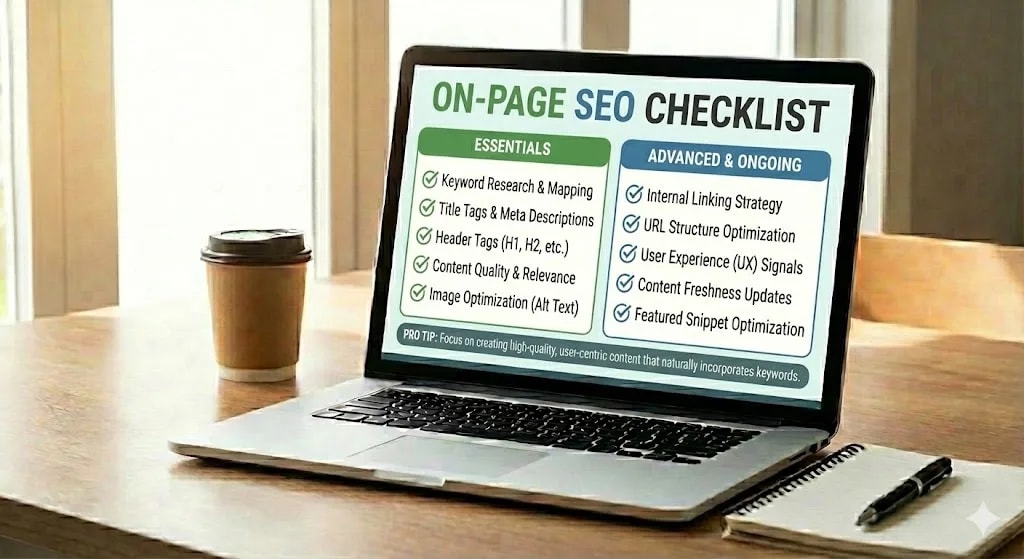
Before you hit publish on any piece, run it through these AI citation guide standards — the same checklist used to audit content for generative search visibility:
The goal of AI SEO is no longer to "game" the system but to "feed" it. By focusing on data-driven content, genuine expert insights, and a page structure that favors AI search engines, you position your website as an indispensable part of the AI's knowledge base — the source it returns to query after query.
Getting cited by AI is not just about traffic. It is about becoming the definitive, named authority in your niche at the exact moment your market is forming its buying decisions inside AI conversations. As generative search continues to expand through 2026 and beyond, the brands that provide the most citable truth will be the ones that dominate the search landscape — and the lead flow that comes with it.
Coming Up in the Next Blog: AI SEO: 8 Steps to Rank Your Website in AI Search Results — a deep dive into technical optimization and Generative Engine Optimization (GEO).
Traditional SEO is like trying to rank first in a phone book — you compete for a position on a list of links. AI SEO is like being the expert a researcher calls for a direct quote. Engines like SearchGPT, Gemini, and Perplexity read your site and quote you inside their answers. Your goal shifts from earning the click to earning the AI citation that establishes you as the authority.
Only if it adds genuine value. If your content is a generic echo of what already exists online, AI engines will ignore it entirely. To get cited by AI, you need Information Gain — personal case studies, unique data-driven content, original statistics, or expert insights that a machine cannot fabricate and cannot find anywhere else.
AI models prefer content that is pre-digested and easy to extract. Use the "Answer Nugget" method: place a clear, complete 40 to 60 word answer directly under each H2 heading. Add FAQ schema, use tables and bullet points for data, and include verifiable original facts — this makes your content the easiest source for the AI to grab, trust, and credit.
Zero-click search happens when a user gets their answer directly from the AI and never clicks your link. While it reduces raw traffic, it is powerful for brand authority — in 2026, being the consistently referenced source builds enormous trust at scale. When that user is finally ready to buy, they search for your brand specifically, delivering the highest-intent traffic your site can receive.
AI engines see the world as a network of Entities — brands, people, products, and concepts connected in a knowledge graph. To rank in AI search results, your brand needs a clear, consistent identity. Keep your business name, location, services, and expertise consistent across your website, LinkedIn, and directories so the AI can confidently "file" you as a trusted, citable expert in your field.


Sep 22, 2026
Facial recognition privacy rules in 2026 explained: BIPA, CCPA, EU AI Act, consent, retention, safer alternatives and a practical implementation checklist.
By Muhammad Hamza · CTO

Your trusted partner in innovative web solutions, delivering tailored development, design, and marketing services to elevate your digital presence and business growth.
info@clyrixdigital.com
© 2026 Clyrix Digital. All rights reserved.